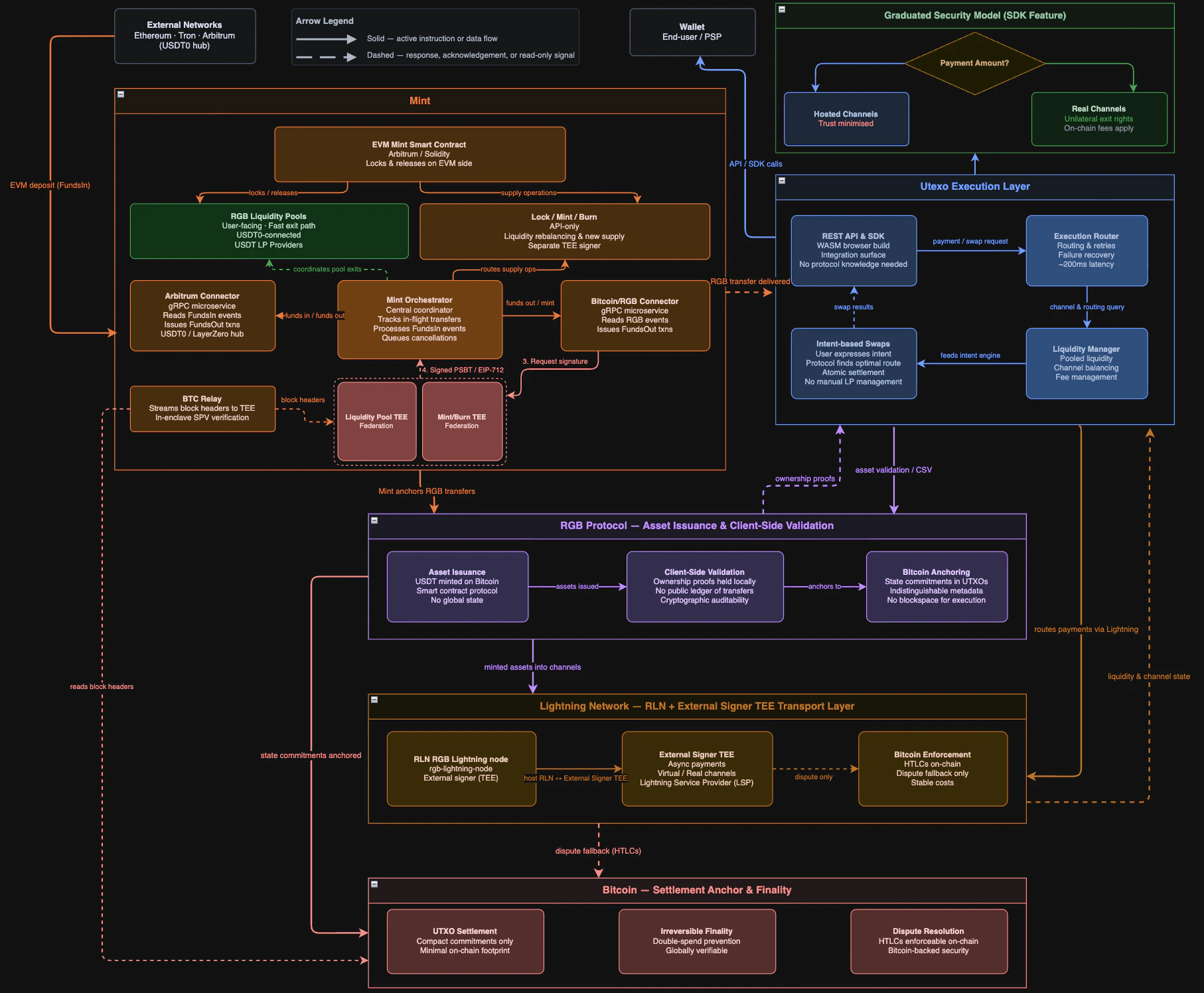
Utexo Architecture
Stack Overview
In the Utexo model, ownership proofs are validated locally by users’ wallets (client-side validation), and each transfer is anchored by an ordinary Bitcoin transaction that carries a cryptographic commitment. There is no global state to synchronise. Each transfer is a direct exchange between sender and receiver, verified against those commitments.
Bitcoin
Bitcoin serves as the settlement and finality anchor for the entire Utexo system. It handles correctness, finality and dispute resolution, acting as the foundational layer that grants irreversible settlement and strong security. This allows Utexo to decouple settlement guarantees from execution cost volatility. What this means in practice:- Individual payments, asset transfers, and balances are not recorded on-chain. Only compact cryptographic commitments derived from Utexo activity are anchored to Bitcoin in the form of UTXOs, indistinguishable from other ordinary metadata.
- By anchoring state commitments to Bitcoin via RGB, Utexo ensures that execution taking place off-chain cannot be arbitrarily rewritten or manipulated without detection.
- This model minimises on-chain footprint while preserving the ability to prove that off-chain execution followed the agreed rules, remaining accountable to a globally verifiable settlement layer.
If off-chain execution were to fail, stall, or behave maliciously, participants retain the ability to fall back to Bitcoin-backed guarantees. This approach allows Utexo to scale payment activity without compromising on the long-term trust model that Bitcoin provides.
Lightning Network
The Lightning Network can carry RGB assets over payment channels. The RGB Lightning Node and the Utexo SDKs support RGB channels, invoices and payments.Lightning is available on test networks only. On mainnet, the node rejects Lightning API calls (
403 LightningUnsupportedOnMainnet) and @utexo/wdk-rgb-lightning throws LIGHTNING_DISABLED_ON_MAINNET. USDT on Bitcoin moves on-chain with RGB today; integrations built on the on-chain path keep working if Lightning is enabled later.RGB
RGB is the smart contract and asset issuance protocol running on top of Bitcoin that enables Utexo to issue and transfer USDT natively on-chain. RGB uses a client-side validation model: contract state is maintained locally by the asset owner, not broadcast to a public ledger. Ownership proofs are committed to Bitcoin UTXOs without revealing transfer details on-chain. What this means in practice:- Asset transfers are private by default. There is no public ledger of individual RGB transfers.
- USDT issued via RGB is a real Bitcoin-layer asset with Bitcoin-backed finality, not a wrapped token on a separate chain.
- The RGB protocol enforces asset supply integrity: issuance, transfer, and destruction are cryptographically verifiable by any participant holding the relevant contract history.
Utexo Execution Layer
The Utexo execution layer is the coordination environment for USDT on Bitcoin. It sits above Bitcoin and RGB and provides the logic that makes the stack usable at the application level. Role in the stack:- Coordinates mints, burns and swaps between USDT on Bitcoin and other networks.
- Manages liquidity for the Mint and Swap, and quotes fees before a transfer.
- Abstracts RGB state transitions and asset validation behind APIs and SDKs.
- REST APIs for the Mint and Swap, and SDKs for wallets
- Liquidity, asset validation and settlement coordination handled by Utexo
- Little protocol-specific logic required in application code
Mint
The Utexo Mint connects external EVM-based and Non-EVM-based networks to the Bitcoin RGB layer, enabling cross-chain USDT transfers in both directions. It is built around Arbitrum as the single EVM settlement hub, with USDT from Ethereum, Polygon PoS, Plasma and Tron supported transparently via the USDT0 / LayerZero protocol. Minted USDT is represented on Bitcoin as RGB USDT, a real on-chain asset with Bitcoin-backed settlement guarantees. The Mint is composed of these coordinated components:- Mint orchestrator that tracks all in-flight transfers in a database and drives each one to completion or cancellation.
- Connectors, stateless chain-specific gRPC services that watch bridge contracts for
FundsInevents and issueFundsOuttransactions. - Bridge contracts on Arbitrum: the Bridge holds locked USDT0, and
MultisigProxyverifies the release signer quorum before any release. - Mint signer, an AWS Nitro Enclave holding the RGB mint rights, that signs the mint PSBT only after verifying the matching USDT0 deposit on Arbitrum.
- Release signer federation, independent signer enclaves of which an M-of-N quorum must sign (EIP-712) every EVM release after an RGB burn.
- BTC Relay, a service that submits Bitcoin block headers to the on-chain
BtcRelaycontract on Arbitrum. Each release signer enclave keeps its own SPV header chain, fed by its host and checked from a pinned checkpoint, and refuses to sign if that chain disagrees with theBtcRelayrecord.
For full component details, supported networks, transfer flow, and security properties, see Mint.
Swap
Utexo Swap is an intent-based liquidity layer for cross-chain swaps across Bitcoin, Ethereum, Tron, and Solana. Resolvers compete to price and fulfill each swap, and every swap settles through a dedicated escrow on the source chain, reducing reliance on centralised venues for rebalancing and conversion. How it works: Swap uses an intent-based execution model with two participants: the user, who initiates the swap and a resolver, who executes it.- Quote - The user requests a quote for their desired currency pair and amount via the Utexo Swap API. The API returns a time-limited execution estimate with all pricing information.
- Intent creation - The user creates a structured intent specifying their addresses and the agreed quote identifier, representing their intention to execute the swap under the quoted conditions.
- Signing - The user signs the intent off-chain, cryptographically authorising resolvers to execute the swap according to the quoted conditions.
- Execution - Utexo notifies the winning resolver, who deposits assets into a per-swap escrow contract. Funds are only released once fulfillment is verified on-chain. The swap either completes in full or reverts, there is no partial execution risk.
For full component details, supported networks, transfer flow and security properties, see Swap.
Further Reading
The Problem
Why existing payment infrastructure fails and what Utexo solves.
What is Utexo
Product overview and integration paths.
Mint
Full Mint component reference, supported networks, and security model.
Swap
Cross-chain BTC/USDT exchange on Bitcoin.